
Integrity in water allocation systems in the face of climate change
When water is scarce, who decides on water allocation, and how?
New research examines integrity risks in water allocation in the face of climate change, with a focus on water permittings systems.
"Transparent rules, public registries of water rights, clear sustainability limits, and accessible grievance mechanisms help ensure that water allocation adapts to scarcity and climate change without systematically disadvantaging certain groups."
In brief:
The systems built to decide who gets water, and how much, are struggling to keep pace with the new realities of climate change and unpredictable water flows. This research looks at different water allocation system and focuses on water permits, which are particularly vulnerable to corruption and integrity risk.
Evidence from Zimbabwe, South Africa, Mexico, India, Pakistan, Indonesia, Tanzania and Spain shows that corruption, political interference, and opaque decision-making are undermining who gets access to water, and that climate change is making this worse.
The paper proposes a framework for understanding integrity and integrity risks at two levels: the integrity of water allocation systems themselves, and the integrity of the administrative processes used to implement them.
There is risk embedded in policy design, legal frameworks, and system structures, and these tend to disadvantage marginalised users.
Fair, transparent and accountable allocation systems are essential for protecting human rights, supporting ecosystems, reducing conflict and building climate resilience.
DOWNLOAD
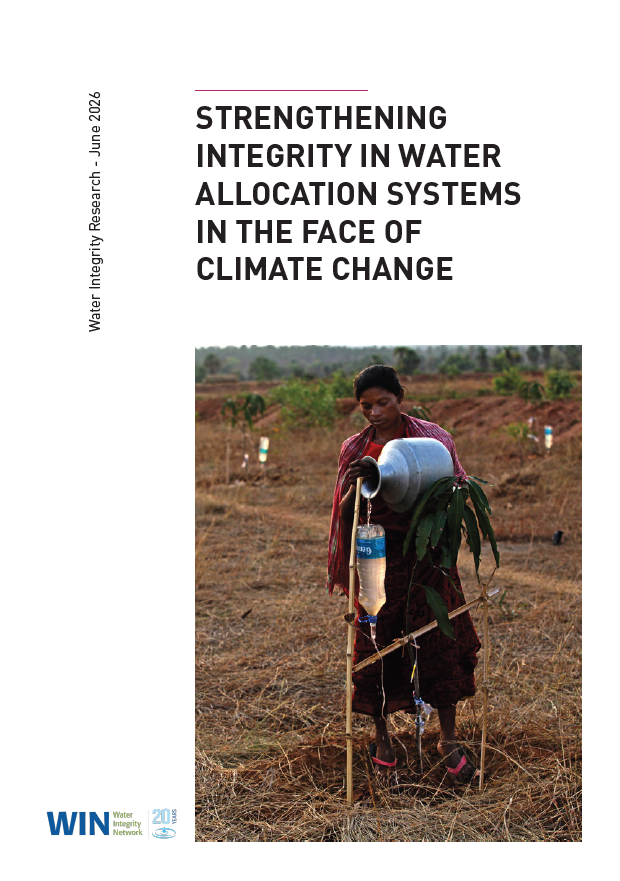
Strengthening Integrity in Water Allocation Systems in the Face of Climate Change
June 2026
This research was supported by the Deutsche Gesellschaft für Internationale Zusammenarbeit GmbH (GIZ).
Keywords: Water allocation | Water permits | Water governance | Water resource management | Water corruption | Climate adaptation | Water integrity | Regulation
Suggested citation: Galvin, M.; Schreiner, B.; van Koppen, B. (2026). Strengthening Integrity in Water Allocation Systems in the Face of Climate Change. Water Integrity Research. Berlin: Water Integrity Network (WIN).
As climate change intensifies droughts, floods and uncertainty, difficult decisions about who gets access to water are becoming increasingly common. Drawing on academic literature alongside in-depth practitioner interviews, this research looks at the systems built to manage these tough decisions and exposes their vulnerabilities.
The paper looks at transboundary water allocation systems and national allocation systems. It zooms in on water permits, showing significant integrity risks at each stage of the water permitting cycle. These include burdensome application requirements that exclude small-scale and marginalised users; bribery to expedite permits or weaken conditions; manipulation of water availability models to justify allocations; political interference in decision-making; and selective enforcement that protects powerful users while penalising smaller ones.
These are integrity risks to how the system is used and implemented in practice. There are also integrity risks in how the systems are conceived and financed. Interviews reveal how deep, systematic failures and exclusions can be built into the system.
Climate change amplifies existing integrity risks. Increased scarcity raises the stakes of every allocation decision. Emergency or drought-response powers can be misused to bypass normal protections. Historical hydrological data is becoming less reliable, creating new opportunities for model manipulation. And already-marginalised groups are most exposed when water is scarce.
Urgent action is needed to strengthen our systems. There are some good examples to learn from, including Kenya's tiered permit system that deliberately reduces administrative burden on small users, or community-based collective water concessions in Mexico. Based on these examples and more, the paper closes with practical recommendations for integrity, for government officials, civil society, international organisations, and donors working on water governance reform, water tenure, and climate adaptation.


Comments